
In this article
Learning Arabic can bring a distant place closer. It can also change how you connect with the people, stories and communities already around you.
Perhaps you want to speak with your partner’s family, understand a favourite song or feel more at home when you travel. You might be exploring a career with an international focus. Whatever brings you to Arabic, the language reaches much further than many beginners realise.
How many people speak Arabic?
The United Nations describes Arabic as a language used daily by more than 400 million people.[1] That gives a sense of its scale without pretending there is one exact, universally agreed speaker count. Estimates differ depending on how they include regional varieties and people who use Arabic as an additional language.
It is also worth knowing that Arabic has different forms. Modern Standard Arabic is the shared formal variety you encounter in much writing and news; regional dialects bring everyday conversations to life. Your learning goals will help determine which combination suits you.
Arabic has a strong place in Australia, too
In the 2021 Census, 367,159 people reported using Arabic at home in Australia. Arabic ranked second among languages other than English used at home, after Mandarin.[2] These are home-language figures, rather than a count of everybody who can speak Arabic.
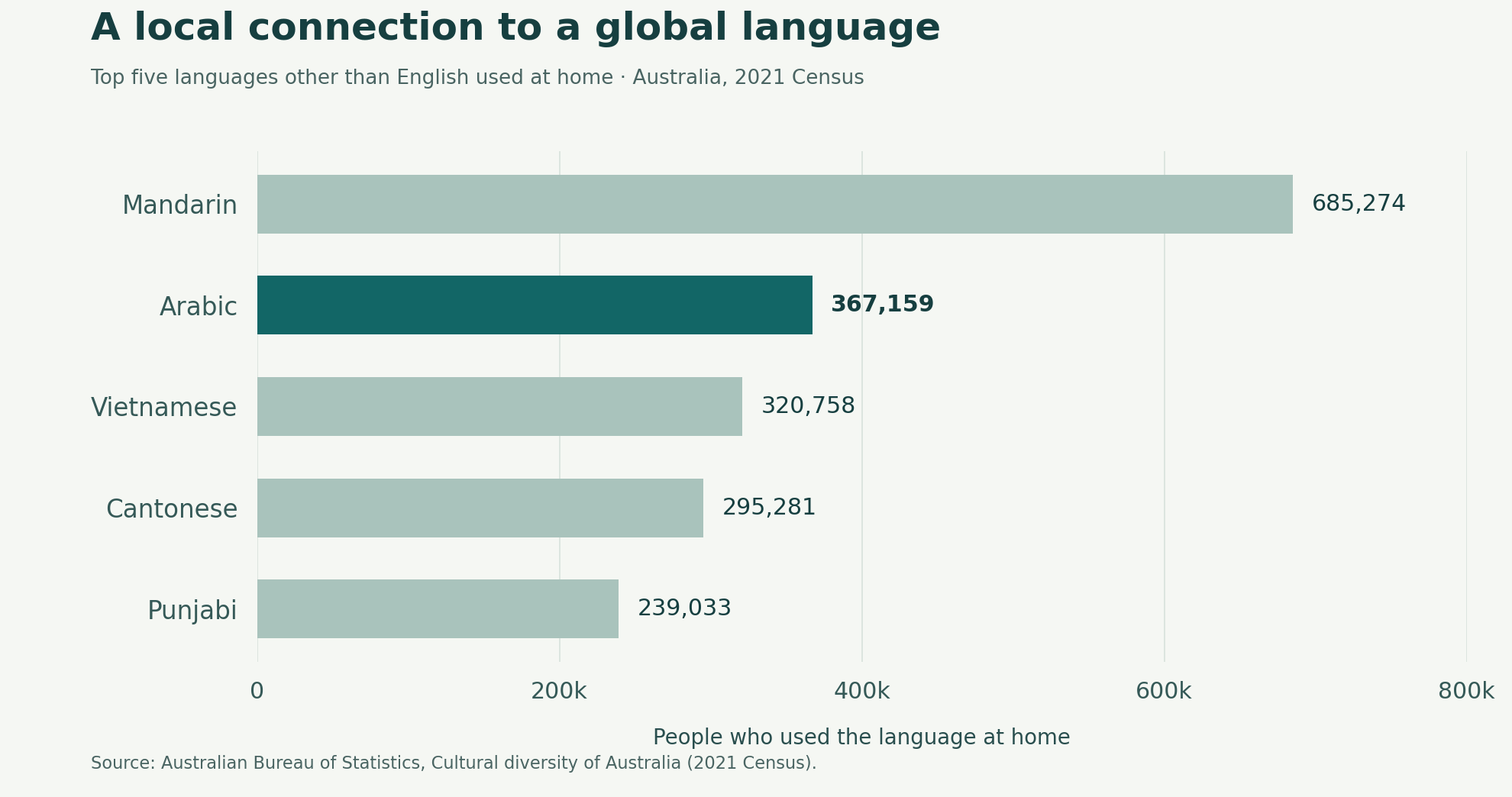
See the Census figures
| Language | People |
|---|---|
| Mandarin | 685,274 |
| Arabic | 367,159 |
| Vietnamese | 320,758 |
| Cantonese | 295,281 |
| Punjabi | 239,033 |
For a learner in Melbourne, that makes Arabic more than a language for a future holiday. It can become part of a conversation with a friend, a community event or a family gathering. Even a simple greeting can show someone that you have taken an interest in their language.
One of the United Nations’ six official languages
Arabic is one of the UN’s six official languages, alongside Chinese, English, French, Russian and Spanish. The organisation uses interpretation and translation so participants can communicate across these languages.[3] Arabic joined the General Assembly’s official languages in 1973, the year behind the choice of 18 December for World Arabic Language Day.[1]
Its international role gives another reason to be curious about Arabic: the language offers access to conversations about public life, culture and issues that cross borders.
What opportunities could learning Arabic open?
The answer depends on what matters to you. For a traveller, it might mean asking a question without immediately reaching for a translation app. For someone with Arabic-speaking relatives, it could mean taking part in a conversation that used to pass them by.
In a professional setting, Arabic may complement skills you already have in business, education, community work or international affairs. The opportunity begins with being able to listen and connect; the language alone does not replace specialist knowledge.
You do not need an ambitious career plan to start. Enjoying a film, understanding a joke or finally reading a café sign can be a worthwhile goal in its own right.
Try our 20 free shadowing stories. Listen, follow the text and take your first small step towards speaking Arabic aloud.
Sources & further reading
- United Nations — World Arabic Language Day
The UN describes Arabic as used daily by more than 400 million people. This is a broad estimate, not a single worldwide census.
- Australian Bureau of Statistics — Cultural diversity of Australia, 2021 Census
Top-five home-language counts and Arabic’s rank; released 20 September 2022. Counts measure use at home, not everyone able to speak a language.
- United Nations — Official Languages
The UN’s six official languages and their role in interpretation and translation.