
In this article
Shadowing means listening to spoken Arabic and repeating it aloud a moment behind the speaker while the audio continues. You follow the voice closely, like an echo, instead of waiting for a whole sentence to finish.
It gives you a focused way to bring listening and speaking together. With a short, familiar text, you can pay attention to a sound, a long vowel or the rhythm of a phrase without having to invent a new sentence at the same time.
Why do we include shadowing?
We use it to create regular opportunities to notice pronunciation and practise speaking aloud between lessons. In a small study of 16 English learners over eight weeks, Foote and McDonough reported improvements in comprehensibility and fluency, but no significant improvement in accentedness.[1] Our practical aim is clear, understandable speech and more attentive listening.
Use shadowing alongside conversation and feedback. Following a recording practises a different task from choosing your own words in a live exchange, so make room for both.
Choose a short story you can mostly understand
Pick a passage where you can follow the overall meaning. If every line contains unfamiliar language, prepare a smaller section or choose an earlier story. The beginner texts in our free library include vowel marks to support reading.
Check the English translation and useful vocabulary before your first attempt. The aim is to know what you are saying, not to reproduce a stream of sounds without meaning.
Listen once, then prepare a few lines
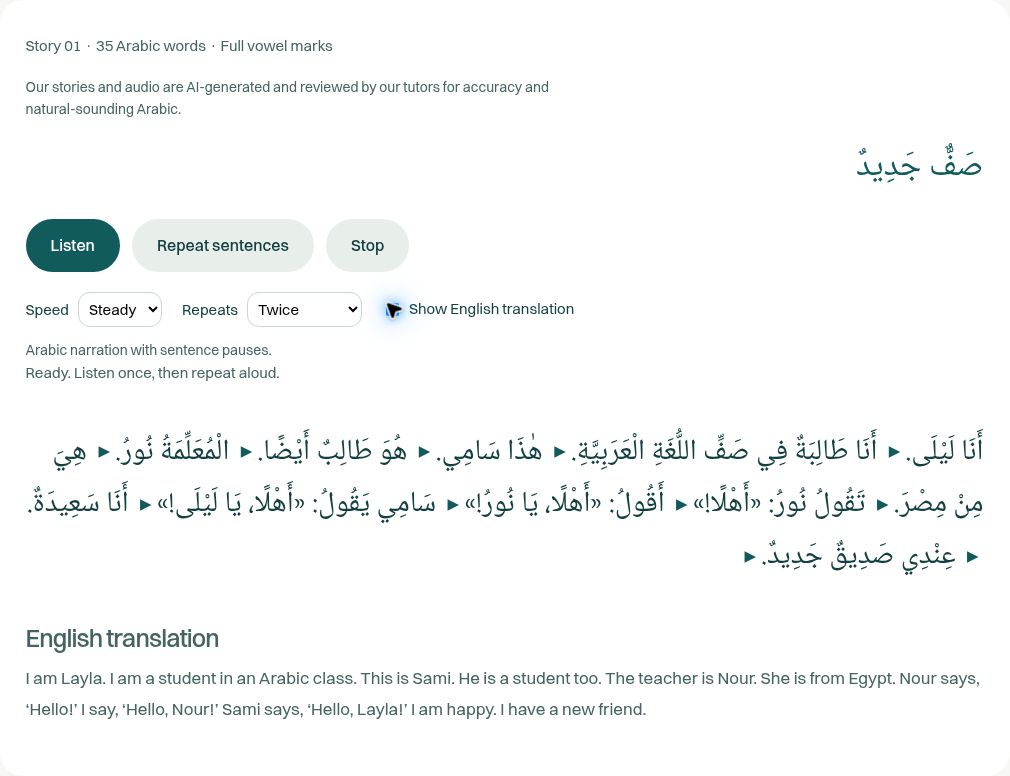
Select Listen and follow the Arabic text without speaking. Notice where the voice groups words together and which sounds you want to revisit.
If a line feels too fast, use its sentence play button or Repeat sentences. Listen, pause and repeat as preparation, then return to Listen for a run through the story. In that run, try to speak just behind the voice while the recording keeps going.
You can adjust Speed and choose how often a sentence repeats. Begin with a setting you can follow, and increase the challenge when you are ready. The recordings include sentence pauses, so use those brief gaps to reset without stopping the whole passage.
Try this ten-minute practice plan
- Two minutes: read a short section and check the meaning.
- Two minutes: listen and prepare the lines that catch you out.
- Three minutes: shadow the passage, staying a moment behind the voice.
- Two minutes: read it aloud without the audio, or record yourself privately.
- One minute: compare one detail and choose what to revisit next time.
This is a suggested way to organise your practice, rather than the research study’s protocol. Shorten the passage or the session when that makes it easier to return regularly.
If you keep losing the speaker
Work with fewer lines and choose one focus. It might be a long vowel, a particular consonant or the way a familiar phrase flows. Check the meaning again if you find yourself looking at the words without following the story.
After practising, try one sentence about your own life using something from the passage. Bring a question or a short recording to your tutor if you would like specific feedback.
What is included in the free library?
Our 20 graded stories include Arabic text, English translations, useful vocabulary, comprehension questions and audio. The stories and audio are AI-generated and reviewed by our tutors for accuracy and natural-sounding Arabic. Suggested course packs are a guide; the final five stories are advanced extensions beyond Intermediate 2.2.
You can explore all 20 stories free, starting with a short vowel-marked text or a passage that matches your current level.
Sources & further reading
- Foote, J. A. and McDonough, K. (2017) — Using shadowing with mobile technology to improve L2 pronunciation
Journal of Second Language Pronunciation, 3(1), 34–56. A small study of English learners; its results are not a guarantee for Arabic learners or this particular routine.